Reading the epistles through Paul’s eyes gave me a fuller picture of Jesus—clear, deep, and personal. Jesus is not just a figure in Paul’s theology—He is the center of everything Paul believed, taught, and lived for. Paul saw Jesus as the Crucified Savior, the Resurrected Lord, the Righteous Justifier, the Head of the Church, and the source of every spiritual blessing. Jesus was Paul’s message, motivation, and model. Every letter Paul wrote was rooted in the truth of who Jesus is and what that means for us. Through Paul, I saw that Jesus is not just the beginning of faith—He is the focus, the fuel, and the finish line.
Friday, December 23, 2022
Thursday, December 22, 2022
Five Things I Learned about JESUS THROUGH THE APOSTLE PAUL’S EYES
Reading all of Paul’s letters together gave me a fuller picture of who Jesus is. Through Paul’s eyes, I saw Jesus as more than just a teacher or miracle worker—He is the Crucified and Risen Lord. That changed everything. Jesus is not just someone I believe in; He is the One who saved me, who still saves me daily. Paul made it clear that Jesus is the Messiah and the Son of God—He fulfilled the promises and revealed the very heart of the Father. And then Paul showed me that Jesus is our righteousness. I do not have to earn right standing with God—it is mine because of Jesus. That truth lifted a weight off me. Paul also painted Jesus as the center of the Christian life. He is not just part of the journey—He is the journey. He shapes how I live, love, and serve. Finally, Paul reminded me that Jesus is the Head of the Church. We are not doing this alone or leading ourselves. Jesus holds it all together—and in Him, so do we.
Tuesday, December 20, 2022
Jesus Is Everything: Through the Eyes of the Apostle Paul
If you read all of Paul’s letters back-to-back, you will
see something more powerful than theology.
You will see a man absolutely captivated by Jesus Christ.
He does not just preach about Jesus—he lives for Him.
Paul calls Him Lord, Savior, Head of the Church, Justifier, Mediator, Redeemer,
and Returning King.
But beyond the titles, Paul shows us what Jesus means to him personally.
Jesus is not a theme in Paul’s writings.
He is the thread.
The source.
The center.
The everything.
Jesus,
the Risen Lord Who Met Paul in Mercy
It started on the road to Damascus.
Paul was a persecutor. A threat. A man full of zeal—but blind.
And then came Jesus.
“Last of all, as to one untimely born,
He appeared also to me.” (1 Corinthians 15:8)
That moment marked Paul forever.
Jesus met him with power and grace.
He did not shame him. He called him.
From that point forward, Paul's mission was clear:
Know Jesus.
Preach Jesus.
Become like Jesus.
Jesus,
the Center of Paul’s Gospel
Paul makes it known: the gospel is not a message about
doing better.
It is the life, death, and resurrection of Jesus—given freely, received
by faith.
“For I resolved to know nothing while
I was with you except Jesus Christ and Him crucified.”
(1 Corinthians 2:2)
Jesus is not a footnote.
He is the foundation.
- In Romans, Jesus is our righteousness.
- In Galatians, Jesus is our freedom.
- In Ephesians, Jesus is our peace.
- In Colossians, Jesus is the fullness of God.
Everything Paul taught points back to this one truth:
Jesus saves. Jesus transforms. Jesus reigns.
Jesus,
the Example Paul Followed
Paul did not just worship Jesus—he imitated Him.
“Follow my example, as I follow the
example of Christ.” (1 Corinthians 11:1)
Jesus shaped how Paul:
- Served others
- Endured suffering
- Spoke truth
- Lived in humility
- Walked in love
For Paul, maturity looked like conformity to Christ.
The more you grow, the more you look like Jesus.
Not in perfection—but in posture.
In purpose.
In daily pursuit.
Jesus,
the Returning King Paul Lived For
Paul never stopped talking about the return of Jesus.
It was not fear-based. It was hope-filled.
“There is laid up for me the crown of
righteousness... and not only to me, but also to all who have loved His
appearing.” (2 Timothy 4:8)
This is how Paul endured beatings, prisons, betrayal, and
loneliness.
He knew Jesus was coming again.
And he wanted to be found faithful.
Jesus,
the Everything Paul Wanted Us to See
Paul’s letters were not written for academics.
They were written for churches, leaders, struggling believers—people like us.
And he wanted all of them to know:
- Jesus is the beginning.
- Jesus is the sustainer.
- Jesus is the answer.
- Jesus is the goal.
“For from Him and through Him and to
Him are all things. To Him be the glory forever. Amen.”
(Romans 11:36)
Let
Jesus Be Your Everything
This final reflection reminded me—
It is not about how much you know.
It is about who you know.
Jesus was everything to Paul.
And I want Him to be everything to me.
So I end this year the way Paul lived his life:
- Rooted in Christ
- Reaching for more of Him
- Ready to reflect Him in word and walk
Because if Jesus is not the center, everything else is
just noise.
Tuesday, December 13, 2022
Five Things I Learned about Good Christian Conduct (Titus)
Titus echoed and reinforced the message Paul gave to Timothy—Christian character matters deeply. The letter was full of practical guidance for how believers should carry themselves in a culture that often runs opposite to the faith. Good Christian conduct is about being consistent in goodness, faithful in service, and honorable in speech. Paul was not just writing for church leaders—he was giving every believer a blueprint for how to live out grace with integrity. It is not just about what we believe—it is about how we behave, how we treat others, and how we reflect Christ daily.
Five Things I Learned about Good Christian Conduct (2 Timothy)
2 Timothy was Paul’s final charge—a powerful reminder that how we live matters just as much as what we believe. Good Christian conduct is not about perfection—it is about consistency, humility, and surrender. Paul painted a picture of a believer who is submitted to authority, committed to doing good, and steady in character. A Christian should be peaceable, teachable, kind, and full of grace. That kind of life speaks loudly, even without a platform. Paul was preparing Timothy to lead by example, not just instruction. These traits are not flashy, but they are holy—and they are needed now more than ever.
Monday, December 12, 2022
Five Things I Learned from the Book of TITUS
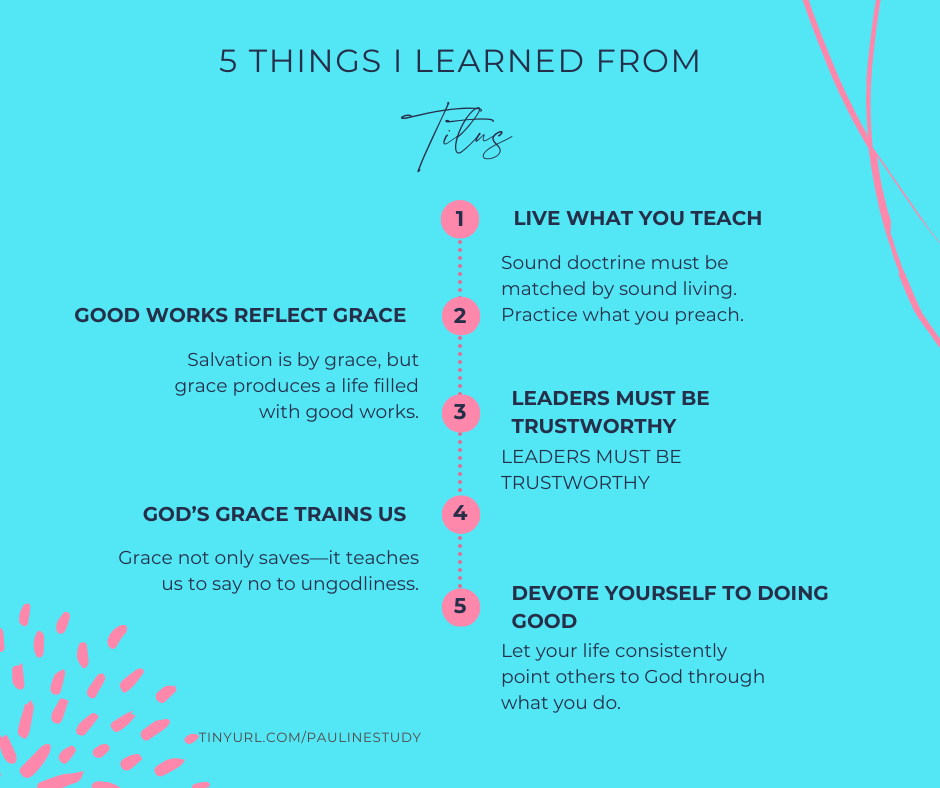
Titus was short but strong—like a pocket-sized manual for Christian living. Paul came with clarity. From the start, he showed that doctrine and lifestyle are not separate—they go hand in hand. What you believe should show up in how you live. That challenged me to ask if my walk matches my talk. I also saw how much Paul valued integrity in leadership. He was not just looking for talent—he was looking for trustworthy people. That mattered. Then he flipped the focus to grace. Not just saving grace, but training grace. That changed how I see discipline. Grace does not just catch me when I fall—it teaches me how to walk right. And when Paul said to devote ourselves to doing good, it felt like a call to action. Our lives should reflect God’s goodness in every space we walk into. Titus may be a quick read, but it leaves a lasting impact.
Five Things I Learned from the Book of 2 TIMOTHY
2 Timothy felt like Paul’s final words—and it read like a legacy letter. There was weight in every sentence. Paul was tired, but not defeated. He was focused on finishing well, and that stirred something in me. He reminded Timothy—and me—to pass the faith on. This walk is not just about us; it is about who is coming next. That made me think about what I am leaving behind. Paul also pushed Timothy to stir up his gift. That hit home. Sometimes I sit on what God gave me, but this letter reminded me to use it boldly, even when I feel unsure. And Paul kept pointing back to Scripture—it is our foundation. With all the noise around us, that truth steadied me. His words about enduring hardship as a good soldier made me sit up straighter. Ministry is not always easy, but it is always worth it. Paul finished strong, and he showed me that I can too.
Saturday, December 10, 2022
Conduct Matters: Good Christian Character in 2 Timothy & Titus
If Paul’s letters were sermons, then 2 Timothy and Titus are life lessons—personal, urgent, and packed with wisdom.
These are letters to leaders.
But they speak to all of us.
Because being a Christian is not just about believing the right things—it is
about living them.
Paul does not just ask these young leaders to preach the
Word.
He tells them to embody it.
To live it out loud.
To walk in good Christian conduct—not for applause, but for witness.
Because character preaches too.
Start
with Submission: Respecting Authority
Paul instructs Titus:
“Remind the people to be subject to
rulers and authorities, to be obedient...” (Titus 3:1)
In a time of Roman oppression, this was no easy ask.
But Paul knew—rebellion for rebellion’s sake does not reflect Jesus.
Good Christian conduct begins with a posture of honor—even
when we disagree.
Not blind allegiance, but Spirit-led humility.
Submission is not weakness.
It is a form of trust—trusting that God sees and leads, even when
systems fail.
Do
Good. Period.
Paul repeats this phrase throughout Titus:
“Be ready to do whatever is good.”
“Our people must learn to devote themselves to doing what is good.”
Good conduct is not passive.
It is intentional, consistent, and visible.
When believers do good:
- Needs are met
- Hearts are softened
- The gospel has credibility
We are not saved by good works—but we were saved to do
them.
Tame
the Tongue: No Slander. No Strife.
“...slander no one, be peaceable and
considerate...” (Titus 3:2)
This one is hard in a culture fueled by opinions and
outrage.
But Paul says: Watch your mouth. Keep your peace. Choose grace.
Christian conduct includes:
- Speaking truth with love
- Refusing gossip
- Choosing silence over stirring division
Our words are windows to our witness.
Be
a Good Worker and a Good Teacher
“Teach what is appropriate to sound
doctrine... in everything set them an example by doing what is good.”
(Titus 2:1, 7)
Paul calls Titus to be both instructor and example.
Your walk has to match your words.
And in 2 Timothy, Paul tells Timothy:
“Be diligent... a worker who does not
need to be ashamed and who correctly handles the word of truth.”
(2 Timothy 2:15)
Whether in ministry or in the marketplace—how we work
and how we teach reflects who we follow.
Be
Kind. Be Gentle. Be Patient. Be Different.
“The Lord’s servant must not be
quarrelsome but must be kind to everyone...” (2 Timothy 2:24)
We live in a loud world.
But Paul calls believers to live quietly strong.
- Not quarrelsome, but gentle
- Not reactive, but patient
- Not prideful, but kind
Because we are not just trying to win arguments.
We are trying to win people to Christ.
Let
Your Life Be the Lesson
These letters reminded me that Christian living is not
complex.
But it is costly.
It means dying to self.
Choosing humility.
Being kind when it is easier to be cutting.
Working with excellence.
Living with conviction and compassion.
So I ask myself:
- Does my conduct draw people to Jesus?
- Would someone want to follow the Christ they see in me?
Because I do not just want to carry the message.
I want to live it.
Live what you believe.
Do what is good.
Let your character match your confession.
Sunday, November 13, 2022
Five Things I Learned about Christian Pursuits
1 Timothy reminded me that
not everything is worth chasing. Paul gave Timothy—and all of us—a list of what
to run after: righteousness, godliness, faith, love, steadfastness, and
gentleness. These are not easy or flashy pursuits. They are quiet, steady, and
deeply spiritual. They require discipline, surrender, and the willingness to
grow even when no one is watching. These pursuits shape character and build
legacy. Paul was clear—what I pursue reveals what I value. Chasing the right
things puts me in position to lead well, live well, and finish strong in faith.
Saturday, November 12, 2022
Five Things I Learned from the Book of 1 TIMOTHY
1 Timothy felt like spiritual
mentorship in letter form. Paul was pouring into Timothy the way I imagine a
seasoned leader pours into the next generation—with honesty, urgency, and love.
What stood out most was his insistence on sound doctrine. Paul was not playing
about the truth—he knew how quickly things could spiral without a strong
foundation. He also emphasized prayer as a priority, and that convicted me.
Prayer is not a side note—it is the starting point for everything. I was also
struck by how much weight Paul placed on godly leadership. It was not just
about gifting—it was about character. And when he told Timothy to set an
example even though he was young, I felt that. Sometimes we disqualify
ourselves because of our age or season, but Paul reminded us that faithfulness
speaks louder than years. Training in godliness takes work, but Paul made it
clear: it is worth it.
Thursday, November 10, 2022
Pursue What Matters: Christian Pursuits in 1 Timothy
1 Timothy is a letter from a mentor to his spiritual son.
It is warm, direct, and deeply pastoral.
Paul is not just giving ministry advice—he is shaping a mindset.
Because Christian maturity is not passive.
It is not accidental.
It is pursued.
And in this letter, Paul gives Timothy—and us—a clear
picture of what to chase after.
Not position.
Not popularity.
Not being liked.
But righteousness, godliness, faith, love, steadfastness, and gentleness.
Some
Things Must Be Fled
Before Paul tells Timothy what to pursue, he tells him what
to flee:
“But you, man of God, flee from all
this…” (1 Timothy 6:11)
All what?
Paul had just addressed false teaching, greed, division,
and pride.
He was exposing what happens when people lose focus and chase things that do
not last.
Before you run toward something, you have to run from
something.
Christian growth means saying no to what pulls you
away from God—
So you can say yes to what draws you closer.
Pursue
Righteousness and Godliness
“...pursue righteousness,
godliness...”
Righteousness is not about appearances.
It is about right standing with God—and living like you know who you
belong to.
Godliness is not stiff or religious.
It is the evidence of a life that takes God seriously.
To pursue these means:
- You care about your integrity.
- You let conviction shape your character.
- You guard your witness, even when no one is watching.
This pursuit is intentional.
You do not drift into righteousness.
You chase it.
Pursue
Faith and Love
“...faith, love...”
Faith is not just what we believe.
It is how we live in trust.
When things go sideways, do we hold on to what God said?
Do we walk by what we know of Him, not just what we see around us?
And love—always love.
Love that serves.
Love that listens.
Love that tells the truth but holds no grudge.
Faith and love are not seasonal.
They are pursuits.
We follow Jesus through them—and because of them.
Pursue
Steadfastness and Gentleness
“...endurance and gentleness.”
That combination stopped me.
Endurance says: I will not give up.
Gentleness says: I will not become harsh while I hold on.
Ministry and maturity both require this balance.
We need grit without becoming cold.
We need tenderness without falling apart.
Paul knew ministry would be hard.
So he told Timothy: Pursue strength that stays soft. Pursue power that still
speaks kindly.
That is spiritual maturity.
What
You Chase Reveals Who You Are
1 Timothy reminded me that you can tell a lot about someone
by what they pursue.
Paul tells Timothy to flee, pursue, fight, and take hold.
That is not casual.
That is committed.
So I ask myself:
- Am I chasing what matters?
- Am I running from distractions?
- Am I putting energy toward the things that shape me spiritually?
Because the truth is—something is always chasing my
attention.
But I get to choose where my feet go.
And I want them running toward righteousness.
Pursue the things that build you.
Pursue the One who called you.
Let your life show what you value most.
Thursday, October 13, 2022
Five Things I Learned about Thinking on These Things
Philippians reminded me that
my thought life is not neutral—it is spiritual. Paul gave a clear filter:
whatever is true, pure, right, holy, friendly, proper, worthwhile, and
praiseworthy—think
on these things.
That list is not random. It is intentional. What I think about shapes how I
live, speak, and respond. This was more than a mental checklist—it was a call
to discipline my focus. In a world full of distractions, negativity, and noise,
Paul challenged me to protect my mind by choosing what I dwell on. Peace is not
found in escaping the world—it is found in fixing my mind on the right things.
Wednesday, October 12, 2022
Five Things I Learned from the Book of PHILIPPIANS
Philippians felt like a deep breath for my soul. It is one of those letters that lifted me and checked me all at the same time. Paul was in prison, yet somehow, joy was pouring off the pages. That challenged me. Joy is a choice, not a mood—and he made that clear. He also reminded me that God finishes what He starts. That gave me hope on the days when I feel stuck or unfinished. I loved how he kept pointing back to Jesus’ humility. Paul told us to have the same mindset, to serve even when we are tired, to love even when it costs something. His words on prayer brought me peace. He reminded me to pray about everything, worry about nothing, and trust that God's peace would guard my heart. And of course, the famous reminder: I can do all things through Christ. Not because I am strong, but because He is. This book is my go-to when I need encouragement to keep going.
Monday, October 10, 2022
Your Mind Matters: Think on These Things in Philippians
Philippians is Paul’s joy letter.
But it is also his thought letter.
From a prison cell, Paul writes with clarity, composure,
and deep contentment.
He is not just telling the Philippians how to live—he is showing them how to think.
Because the mind is not a side conversation in the
Christian life.
It is the battlefield.
And Paul is clear: If you want peace, protect your thoughts.
Think
About What You Are Thinking About
Paul writes:
“Do not be anxious about anything… but
in every situation, by prayer and petition, with thanksgiving, present your
requests to God…” (Philippians 4:6)
This is not a denial of hardship.
It is a redirect of focus.
Anxiety begins in the mind.
But so does peace.
Paul is not offering a quick fix.
He is teaching a habit:
- Pause.
- Pray.
- Thank.
- Think differently.
This is the spiritual discipline of mental alignment.
Fix
Your Mind—Not Just Your Mood
After prayer comes the pivot:
“Finally, brothers and sisters,
whatever is true, whatever is noble, whatever is right, whatever is pure,
whatever is lovely, whatever is admirable... think about such things.”
(Philippians 4:8)
Paul gives us a thought list.
Not just for meditation—but for mental maturity.
This is the kind of thinking that brings:
- Stability
- Peace
- Emotional clarity
- Discernment
These words are not fluff.
They are filters.
When the world is loud, the mind needs boundaries.
And this is the Holy Spirit’s framework.
Let These Things Rule Your Mind:
- True – Think on what God says, not what
fear says.
- Pure – Think clean, not cluttered.
- Right – Think aligned, not distorted.
- Holy – Think set apart, not stuck below.
- Friendly (Loveable) – Think kind, not critical.
- Proper (Honorable) – Think noble, not messy.
- Worthwhile – Think lasting, not shallow.
- Praiseworthy – Think uplifting, not divisive.
Paul is telling us:
You cannot live well if you think recklessly.
Mature Christians learn to take every thought captive and submit it to
Christ.
Right
Thinking Leads to Right Living
Paul ends this section with a promise:
“And the God of peace will be with
you.” (Philippians 4:9)
We often want peace to come first.
But Paul teaches us: peace follows obedience.
When I:
- Pray
- Guard my mind
- Filter my thoughts
- Walk in what I have learned
—then peace comes and stays.
Not because life is perfect.
But because my mind is stayed on Jesus.
Train
Your Thoughts. Live in Peace.
Philippians reminded me that my thought life is not
invisible to God.
He sees it.
He speaks to it.
He calls me to discipline it.
So I ask myself:
- Are my thoughts helping or harming my walk?
- Am I feeding peace or fueling anxiety?
- Do my thoughts sound like heaven or like the news cycle?
Because I want peace.
I want joy.
I want to think on the things that build me up and honor God.
So today, I will choose my thoughts on purpose.
I will set my mind.
I will take every lie captive.
And I will think on these things.


.png)
).png)